Juno,
Thanks for sending these. I must admit, I appreciate you sending us the Miami area papers every day, but I sure love to hate those writers.
This was all good, useful information.
Thanks!!!
Oliver Barry, CRS, GRI
Bob Parks Realty, LLC
Real Estate Broker
145 Maple Row Blvd
Hendersonville TN 37075
Phone: 615-826-4040
Mobile: 615-972-4239
From: gatornews@googlegroups.com [mailto:gatornews@googlegroups.com] On Behalf Of JunoGator
Sent: Monday, September 15, 2014 10:08 PM
To: Randy Lyons
Subject: [gatornews] Gatornews from Alligator Army, Gatorzone and ESPN, courtesy of JunoGator
Muschamp, Gators Look to Tidy Things Up for Tide
Gainesville, Fla.
·
·
·

By Chris Harry
GatorZone.com Senior Writer
The heart-pounding victory over Kentucky Saturday night was fraught with mistakes and missed opportunities. Florida coach Will Muschamp said as much afterward, and did so again Monday.
But, Muschamp also reiterated an important offshoot -- besides the fact that the Gators won the game -- regarding the flaws that showed in UF's 36-30 triple-overtime win over the Wildcats at The Swamp.
"They're all correctable," he said.
That, of course, is a very good thing for the Gators (2-0, 1-0), who will spend the week doing some clean-up work as they prepare for Saturday's nationally-televised showdown against third-ranked Alabama (3-0, 0-0) at Bryant-Denny Stadium and look to build on explosive back-to-back performances by an offense that is averaging 593.5 yards per game under new coordinator Kurt Roper.
It's what the offense has shown Muschamp, with its ability to create explosive plays down the field, which makes him so encouraged about the prospect of the Gators as they move into the meat of their Southeastern Conference schedule. Simply put, the coaches and players did not have that belief -- or confidence -- in the unit last year.
Muschamp said as much following Saturday's sigh-of-relief win, adding that was never an easy thing for a coach to admit. But, it was true. And, to a man, everyone on the team knew it then.
Just like everyone on the team knows this version of the Gators is different.
"Like we've been saying, it's a new year, a new season," said quarterback Jeff Driskel, who has completed 64 percent of his passes for 543 yards, four touchdowns and one interception, and has developed quite the working relationship with sophomore wideout Demarcus Robinson (21 catches, 339 yards, 3 TDs). "It's just nice to know that this unit can do it."
Doing it against Alabama, which has given up just one touchdown in three games, will be an altogether different challenge.
In a perfect world, the Gators would like nothing better than to maintain a ground game averaging 248 yards per outing, but that's not realistic against a Bama defense surrendering just 47 rushing yards a game. UF also needs to shore up its pass protection, which got leaky at times against Kentucky and forced Driskel to hurry throws.
Junior offensive tackle D.J. Humphries will miss his second straight game with an ankle injury. The spotlight will be on the guys up front protecting Driskel, most notably senior Chaz Green (who moved from the right to left side to replace Humphries) and redshirt freshman Rod Johnson, and edge protections against a Bama pass rush led by guys like linemen Davlin Tomlinson and Jonathan Allen, plus linebackers Xzavier Dickson and Trey DePriest.
"They'll give us some different looks and we'll have to adjust to those situations," Muschamp said.
Such will be the case on the defensive side, as well.
Muschamp and his staff went into the 2014 season knowing the UF secondary was loaded with players long on talent, though short on game repetitions. Some of that lack of experience reared itself as Kentucky rolled up 450 yards of offense, including a troublesome six plays alone that totaled 173 yards.
Blown assignments led to tentative play on the back end. Plus, the pressure from the front seven could have been better.
Sophomore cornerback Vernon Hargreaves III on the former: "Everybody gets beat. It was miscommunication. We all got to be on the same page, got to practice better. We all got to understand what needs to be done. They understand that. They know. And we'll get better. We'll get better as the season goes on."
Muschamp on the same subject: "You look at it from a positive standpoint [in that] a young player goes through a very tough deal in front of 90,000 people and obviously everybody knows he's probably somewhat responsible for what happened. ... And, then he rebounds himself and comes back and plays well in the game, and really settles down from there and plays extremely well. ... You're not looking at it going, 'Wow, we couldn't cover this guy.' That wasn't the case."
To ask the likes of Keanu Neal, Alex McCalister, true freshman Jalen Tabor and the handful of others with limited real-time reps not only to correct their miscues but play far more soundly against a Crimson Tide offense averaging 568.3 yards per game -- against a wide receiver in Amari Cooper (33 catches, 454 yards, 2 TDs) who might be the best in the country -- may seem like a tall order, but similar breaches in scheme will prove fatal in one of the nation's toughest venues. In other words, they'll have to. Period.
That's what the Gators are facing this weekend.
Makes you wonder how a young team will react.
"They'll be fine," Muschamp said.
Excited, too.
"We haven't been on the road yet and that's a good way to start," Driskel said. "I bet some of the guys will be a little wide-eyed at first, but at the end of the day it's playing football and that's what we're going to have to. If some young guys are called upon, they're going to be expected to play well."
Gators Found A Way When They Had To
·
·
·

By SCOTT CARTER
GatorZone.com Senior Writer
GAINESVILLE, Fla. – When the end finally arrived, at that moment Matt Jones plunged into the end zone and the officials signaled touchdown, it was 12 minutes shy of midnight.
Jones' score ensured that the first triple-overtime game in Florida football history was one the Gators would want to remember. No extra-point needed.
His 1-yard run capped Florida's four-play, 25-yard game-winning drive. Actually, it was Jones' four-play, 25-yard drive as quarterback Jeff Driskel turned and handed the ball to the junior running back on every play.
"I didn't care who scored,'' Jones said. "I just wanted to win that game."
Jones had a lot of company.
More specifically, most of the 88,000 souls inside Ben Hill Griffin Stadium and countless Florida fans watching elsewhere as the Gators pulled out a 36-30 thriller over Kentucky in both teams' Southeastern Conference opener.
This one had a little bit of everything. And then some.
Once it was over, it was difficult to imagine the game was tied 3-3 at halftime.
"There's going to be games like that when you play in our conference,'' Florida head coach Will Muschamp said. "You've got to find ways to win those games and our guys found a way to win the game."
The Gators would have been nowhere near their 28th consecutive victory over Kentucky if not for sophomore receiver Demarcus Robinson. Coming off a six-catch, 123-yard game against Eastern Michigan, Robinson had the game of his life Saturday night at an electric Swamp.
"I never had a game like this in high school,'' he said.
Robinson matched a 45-year-old school record with 15 catches for 216 yards and two touchdowns. He tied former UF receiver Carlos Alvarez's record for receptions in a game, set in 1969 in a win at Miami.
Robinson's most important reception came on a fourth-and-7 play from Kentucky's 9-yard line in the first overtime. If the Gators didn't get a first down or touchdown on the play, the game was over.
Kentucky led 27-20 by scoring on its first play of overtime on a 25-yard screen pass from Patrick Towles to Stanley Williams.
The Swamp was one play away from a meltdown when Driskel took the snap and floated a pass into the left corner of the end zone. Robinson ran under it for the score.
The Gators lived. The Swamp roared. Kentucky coach Mark Stoops looked like he wanted to choke someone, convinced the play clock had expired prior to the snap.
The refs didn't think so and the game played on.
In the second overtime the teams exchanged field goals. In the third, after Wildcats kicker Austin MacGinnis missed a 41-yard field goal, the Gators took over and turned the rest of the game into Jones Time.
Jones finished with 29 carries for 156 yards. The Gators racked up 532 yards of total offense, including a career-high 295 yards passing from Driskel, who completed 25 of 43 passes with three touchdowns and one interception.
There were plenty of tense moments for the Gators, none moreso than those seconds leading up to Driskel's pass to Robinson for the game-tying score in the first overtime. Florida's first loss to the Wildcats since 1986 seemed possible and probable.
You know how that would have played out, much the same way as last season's losses to Vanderbilt and Georgia Southern.
Coming off a promising 65-0 win over Eastern Michigan – and with a trip to No. 2-ranked Alabama on tap next week – a loss to the Wildcats was the last thing the Gators needed Saturday.
Gator Nation, too.
The hope provided by the arrival of a new season and the Gators' explosive win in the opener turned the mood around. Life after 4-8 might not be so bad after all.
A loss to Kentucky would have spoiled that vibe. Fortunately for the Gators, they survived and have another week to prepare for their first trip to Alabama since 2010.
"I just think we've got a lot to work on,'' Muschamp said. "Our guys fought. It wasn't always pretty at times."
But it was a W. Florida's first in the SEC since a victory over Arkansas nearly a year ago. The victory over Kentucky snapped the Gators' five-game conference losing streak and sets up an intriguing matchup next week in Tuscaloosa.
The Gators can serve notice they are truly back with a win over the Crimson Tide. Driskel's pass to Robinson showed the Gators can muster magic when they have to.
How much and how often we don't know. In the end Saturday, as the clock neared midnight, they won. A win they needed.
Jones never saw the refs signal touchdown. He could only hear the roar of the night. That was all he needed.
"It was crazy,'' Jones said. "I was at the bottom of the pile. I heard the crowd go wild. My teammates were on my back. I couldn't even get up because they were celebrating.
"It was just a great feeling."
One the Gators certainly preferred over the alternative.
Gators Notebook: Robinson Breaks Out, Jones in Clutch, Muschamp on Resolve, More Tidbits
·
·
·
By SCOTT CARTER
GatorZone.com Senior Writer
GAINESVILLE, Fla. -- Near the end of the first quarter Demarcus Robinson took a pass from Jeff Driskel and turned the play into a 51-yard reception.
Former Gators receiver Lee McGriff, perched high above Florida Field in the radio booth, said what many were probably thinking at the time.
"These are things I've been hearing about but never seen,'' McGriff said.

Robinson was just getting started. By the time he walked off the field following Florida's 36-30 triple-overtime win against Kentucky, the sophomore receiver from Peach County (Ga.) High had 15 catches for 216 yards and two touchdowns.
Robinson set a school record for most receptions in a home game, a record previously shared by Percy Harvin (13 vs. Ole Miss in 2008) andAndre Caldwell (13 vs. Florida Atlantic in 2007). HIs 15-catch performance tied Carlos Alvarez'sschool record for most catches in a game, set in 1969 at Miami.
"The way they were playing us was a lot of one-on-one. They were bringing a lot of pressure,'' Florida head coachWill Muschamp said Sunday on his TV show. "In those situations you want to go to your matchup guys. We went to Demarcus a lot."
Yes they did, 21 times to be precise. Robinson delivered, including a pair of 9-yard touchdown grabs.
The first gave the Gators a 20-17 lead late in the third quarter. Robinson's second touchdown came on fourth-and-7 with the game on the line. Quarterback Jeff Driskel threw a pass into the corner of the left end zone that Robinson hauled in to force a second overtime.
"I was definitely nervous at the time,'' Robinson said of the play that kept the game alive. He had one thought as Driskel's pass sailed his way: "Come to me before the defender gets to me."
After a disappointing freshman season in which Robinson was suspended twice and caught just five passes for 23 yards, he has 21 catches and is averaging 169.5 yards per game two games into the season. He became the first UF receiver to surpass 200 yards in a game since Taylor Jacobs 12 years ago.
His performance Saturday night is one to remember.
"I never did that before,'' he said.
JONES CARRIES LOAD
Junior running back Matt Jones is healthy. It shows.
Coming off a season in which he missed camp due to a viral infection and played in only six games before a season-ending knee injury, Jones was at his best on the game's final drive.
Jones carried four consecutive times for 25 yards, the final carry a 1-yard plunge that gave Florida the victory. He finished with 29 carries for 156 yards.

Running back Matt Jones scampers for a nice gain Saturday vs. Kentucky. (Photo: Tim Casey)
"It was great to get back from last year and having this happen to me,'' Jones said afterward.
As for that final drive, Jones was ready.
"We had to get some tough yards,'' he said. "They just wanted to keep on pounding and pounding and eventually we were going to pop one."
On the game-winning drive, Jones had runs of 3, 16, 5 and 1 to close out Florida's 28th consecutive victory over the Wildcats.
"Matt's a guy that we felt like the inside run game was really working the way they were playing their 3-4 with their overhang backers,'' Muschamp said. "We weren't doing very much on the perimeter in the run game, but he's 235 pounds and when he gets in a pile, he moves the pile and will gain four yards when he breaks a tackle."
Jones' highlight in 2013 came at Kentucky when he rushed for a career-high 176 yards in Florida's 24-7 victory. However, he went down for the season two games later at LSU.
"He's an incredible player,'' tight end Tevin Westbrook said. "To be able to block for him and know he's going to give it his all, you can't ask for much more than that."
SECONDARY CONCERNS
Sophomore safety Keanu Neal had two interceptions Saturday, the first UF player to do that since Ahmad Blackin the 2011 Outback Bowl against Penn State.
Both of Neal's picks came off deflections. Brian Poole also picked off one of Kentucky quarterback Patrick Towles' passes.
While those plays were huge for the Gators, they also had some breakdowns in the secondary. Muschamp said the Gators gave up six plays totaling 173 yards that were related to miscues on the back end of the defense.
Towles completed 24 of 45 attempts for 369 yards, the most passing yards the Gators have allowed under Muschamp.
"We had good coverage at times, but at times we can't just cut a guy loose in the secondary for a touchdown," Muschamp said Sunday. "The big plays, we've got to stay away from. You just can't do that and win in our league consistently."
QUOTE OF NOTE I

"There's going to be a lot of good come out of that as the season rolls on here. As you hit the SEC schedule, it's a series of one-game seasons." -- Muschamp on Saturday's nail-biter over the Wildcats
QUOTE OF NOTE II
"We weren't perfect but it was a perfect effort. They left it all on the field.'' -- Kentucky coach Mark Stoops on his team
QUOTE OF NOTE III
"The way our kids responded was the right way. We never blinked. Our guys understood the situation, the task at hand and what we needed to do to be successful [in overtime]." -- Muschamp on Gators' resolve
200 AND 100
Robinson and Jones combined to do something Saturday that had been done only three other times in school history: a 200-yard receiver and 100-yard rusher in the same game.
The others to accomplish the feat:
--Tommy Durrance (117 yards rushing) and Alvarez (237 yards receiving) on Nov. 29, 1969, at Miami
--Terry Jackson (135 yards rushing) and Travis McGriff (213 yards receiving) on Oct. 3, 1998, vs. South Carolina
--Earnest Graham (182 yards rushing) and Jacobs (246 yards receiving) on Aug. 31, 2002, vs. UAB
EXTRA POINTS
The Gators improved to 4-2 in overtime games and have won four in a row ... The Gators extended the nation's longest scoring streak to 324 consecutive games. Florida has not been shut out since a 16-0 loss to Auburn in 1988 ... The Gators have won 10 consecutive SEC openers ... Punter Kyle Christy was excellent Saturday, showing a form similar to his 2012 season. Christy averaged 48.7 yards on six punts and pinned the Wildcats inside the 20-yard line four times ... Senior receiver Quinton Dunbar finished with two receptions, extending his school record of at least one catch to 30 consecutive games ... Westbrook's first career touchdown came on a 10-yard pass from Driskel in the third quarter ... Driskel, tight end Clay Burton, receiver Andre Debose and linebacker Neiron Ball served as captains.
Florida vs. Kentucky: Was that good, bad, ugly, or something else entirely?

Kim Klement-USA TODAY Sports
The optimist in me has the strongest voice.
You all know this. It's why I'm suffuse with hope, bullish on chances, almost always looking for the bright side of anything — even if it's not Florida sports.
That guy thinks Florida went through a crucible last night, and will be better for it.
Florida hasn't won a game like this in two years. Last year, Florida lostfour games like this, four games that were decided by one possession. Miami. Georgia. South Carolina. Georgia Southern. Throw in an LSU game that felt like a one-possession affair and was decided by 11 points, and the Gators had what was about the 2000s' worth of despair in close games in one year.
The 2013 Gators don't win this game if it's the third game of the season, either. Tyler Murphy, inserted for an injured Jeff Driskel, doesn't throw Florida out of it like Driskel did. Matt Jones isn't at full strength. Neither is Demarcus Robinson. That team probably does a better job against the pass, and just as good a job against the run; Dominique Easley would've helped immeaurably.
But Kentucky hitting bombs would have tested the will of that team. And without a passing game to speak of, how could Florida have responded?
This Florida team could, and did, even if it took until the shadow of midnight to put Kentucky away. That's an improvement, and even if we want to see a better team, and more improvement, last year taught me to not take that for granted.
And, hell, Kentucky looked good last night, and might be good for the first time since 2007, and maybe just the second time in my lifetime. This team had talent, a coherent game plan — arguably better than Florida's — and verve. Given how spotty every team in the SEC East has looked, with the exception of Missouri, I think it might upset someone eventually.
And Florida's leading the SEC East! South Carolina's win over Georgia means that Florida controls its own destiny, and that the other two teams often thought of as part of a three-team race for the division this year.
If we're grading on outcomes and not process, this wasn't bad at all.
And then there's this niggling thought I have: Florida didn't get many bounces, and even a few more going its way could have changed the game entirely. There were maybe a half-dozen almost-picks in this game. Refs missed calls on Kentucky with greater frequency than on Florida. A fumble forced by Dante Fowler, Jr. on one of the most impressive pass rushes I've seen in a while fell to Kentucky. Keanu Neal got screened by Jabari Gorman, which turned a long pass into a touchdown pass. Kentucky got a knuckleball field goal to tie the game late. Kentucky's first overtime touchdown was a ridiculous field-reversal run that required luck and some blown assignments.
Florida got lucky at crucial moments, too, but, on balance, I'd say Kentucky was luckier. And Kentucky was playing better, or certainly closer to its A game, than Florida was.
And Florida still won.
There were better teams that didn't win, and lost to potentially lesser teams, on Saturday.

But the way Florida played should give us pause.
I don't think Florida expected Kentucky to fight like it did; whether that was an issue with the Gators' preparation and motivation, or an issue that really only arose after Florida failed to score early in the first half, or an issue that wouldn't have been an issue had Florida only hit a few big plays, or an issue that would've been rectified by Vernon Hargreaves III simply catching that wobbler from Patrick Towles in the third quarter, it was an issue.
And Florida's had issues with "inferior" teams playing up to the Gators repeatedly under Will Muschamp. I don't need to recap all of those close games: You know them.
Florida also doesn't have many teams as "bad" as Kentucky left on its schedule. Eastern Kentucky's worse, for sure, and Vanderbilt probably is, too, but that's two teams — six of Florida's seven other foes are in the S&P+ top 20, and the seventh opponent, Tennessee, will be waiting for the Gators in Knoxville and hoping for a landmark win.
At a minimum, the way Florida struggled in this game is a reminder that this schedule is going to be very, very difficult on a weekly basis, and that the Gators don't have an enormous margin for error. After a week of feeling nearly untouchable, that's a rude wake-up call.
And, hell, if you want to take the truly pessimistic view, it's that an unprepared Florida team was shown up by a far lesser Kentucky team, had to be gifted a win, and has no clear way forward to improvement.
Here's a list of questions that I can ask if I'm being really skeptical, just off the top of my head:
· Is Driskel going to suddenly get much, much better at reading the field?
· What happens when teams can lock up Demarcus Robinson and force other receivers to beat them?
· How bad is Florida's secondary if an unheralded true freshman who wasn't even listed on Kentucky's roster — Garrett Johnson — could burn it repeatedly?
· Will Florida's defensive line look as stout against the run against an offensive line like Alabama's?
· Don't those field goal misses by Frankie Velez and Austin Hardin mean that Florida's got to go for it more often, and doesn't the recent inefficiency on third and fourth downs mean that's a bad thing?
· What happens when Florida isn't forcing four turnovers per game?
· How will Florida flip the field if Kyle Christy reverts to 2013 form, or Andre Debose gets hurt?
· Will Florida's receivers ever solve their problems with drops?
· How much does Florida already miss Jake McGee and D.J. Humphries?
Saturday night's game reassured Florida fans in one way only: It was a win. It didn't meet expectations, and it frustrated the hell out of a fan base that hasn't taken frustration well of late, and it can be read as a bad omen in so many ways.
The truth probably requires some triangulation.
Florida's secondary looked young, but Florida's offense could've covered for that with better execution and more points early, because it's easier to play from ahead, and the secondary still came within half-steps of half a dozen picks. Florida's offense took a while to get into gear, sure, but the Gators scored when they had to, which is why they won. (Florida's offense kinda rescued its defense for one of maybe two times in the Will Muschamp era!) The Gators got breaks, but had a laundry list of missed opportunities, too.
It's almost never as good as it seems when it's good, and almost never as bad as it seems when it's bad, and beauty (or ugliness) is always in the eye of the beholder. Middle ground is hard to find in any argument or discussion, but middle ground is where most people actually stand.
It's where Florida stands, too, in all probability. We want to know whether they will push forward or fall back — and we will, and probably not much more than five days from this moment long.
Florida vs. Kentucky, Monday Morning Film Study: The sky is not falling

Kim Klement-USA TODAY Sports
The Monday Morning Film Study is a new feature from Trevor Sikkema that will examine some of the key concepts from Florida's games. It will run on, er, Monday mornings. Probably.
Well, that happened.
Florida was able to barely squeak by a Kentucky team that gave the Gators all they could handle down in Ben Hill Griffin. But that result created a lot of negativity among Gators fans befuddled as to how and why Kentucky was able to contain Florida so well and push them to the wire. After all, this was "just Kentucky," right? Since the 'Cats were oh for their last 27 tries against Florida, shouldn't that have meant their team this year would just lay down and take the loss?
I mentioned on Saturday that Kentucky was bringing its best roster in a long time to Florida, and I meant it. They proved that to be true. So people were wrong about Kentucky rolling over.
But that doesn't mean people are right about their concerns about Florida.
Florida was able to maintain a balanced offensive attack with 295 yards passing paired with 237 yards rushing, but was that ideal? The way the game played out certainly says no, but numbers don't always tell the right tale. Demarcus Robinson put on one helluva performance, but after his 15 receptions, Florida's next leading receiver recorded just two.
Following a game where six Florida running backs recorded carries against EMU, the Gators used just two backs against UK, with Matt Jonesgaining 65 percent of the team's total rushing yards. Doesn't a spread offense need to spread the wealth to succeed? Maybe, but maybe not.
As I watched the game initially, I watched what I thought was Kentucky's game plan putting Florida's to shame. I watched UK make halftime adjustments, while UF seemed to regress in their attack. But after going back to the tape, that wasn't a faulty game plan — it was just a perfect storm of poor execution.
If you recall my piece previewing Kentucky's defense going into Saturday's matchup, you remember me focusing on the speed of Kentucky's defense being their strength. They traditionally run their defense out of a 3-4 formation, but slightly tweak it to more of a 3-3-5, getting as many defensive backs on the field as possible. UF still had tons of trouble against a smaller defense (in terms of size), though, because UK's defensive backs were all very solid tacklers on this night. They were not afraid to help in run support, and substituting an extra DB in did not hurt them against the run ... unless you expose them a certain way.
Really, though: All of the above is a preface to how Jeff Driskel's slow start really hurt Florida as the game progressed.

The image above is from early in the contest, and as you see, Florida is in spread formation (which is good, since UF should've been looking to stretch UK's defensive backs away from the box). Look over the screenshot and tell me where you think the ball should be going based off the type of coverage and possible open space. I'll wait.
The answer was a deep ball to Dunbar off press coverage, and that was the right decision! Unfortunately, Driskel was a bit off. But that's not a major problem in isolation — all QBs miss throws. The problem was when this became a recurring theme. Driskel was just 3-for-10 in the first quarter, and that was before throwing his interception.

Here's another look at a formation where Driskel should've had success. Kentucky's not much of a press coverage team. Quick routes and precise timing with receivers should've picked this kind of a formation apart — and Florida basically did that, except it didn't finish the play. Driskel makes the right read on this play to Robinson, who is able to create separation beyond the first down marker, but he drops it. That's "just" a drop, but on third and five, plays like that can sit in the mind as a failure — Will Muschamp mentioned this drop, along with Latroy Pittman's early one, in his postgame comments to ESPN's Maria Taylor while still on the field.
Then you question the execution. Then you question the play calling. It all snowballs.
Kentucky came into the game wanting Driskel to throw the ball, and he was able to ... but when couldn't convert, the box began to stack and the complex blitz packages came out in bunches. For the most part, I think Driskel was able to read the defense well, but it just seemed like he couldn't get into a rhythm with his execution.

Now, the formation that dominated Florida's offense for most of the second half was actually more of a wing formation. A wing formation is a power look, with two receivers split wide, and a tight end a step back from the line a scrimmage, free to move as directed by the quarterback when he analyzes the defense in the pre-snap. This formation is a fun one for teams looking to establish the power running game — something Florida definitely wants in a vacuum, and absolutely wanted on Saturday.
In the screenshot above, we see Kentucky's linebackers playing two or three yards off the trenches, which allow them to read and flow to the direction the ball carrier is headed. But that's not how defenses will have success against Florida in the wing. To really have success, they will need to clutter the line of scrimmage with at least one more blitzing player and would also need to disguise another rusher somewhere else. This would force the pulling lineman to pick up a player on the fly, which is tough to do in the spur of the moment. On this play, Matt Jones does a nice job of following his pulling blockers, and almost gets into the end zone.
At first, I wasn't a fan of how much Florida was using the wing formation. I thought it brought too many bodies into the box, and really ignored what would be one of Kentucky's weaknessness, spreading the defensive backs out and forcing their linemen and linebackers to win one-on-one assignments. Once Kentucky started to realize the Gators had trouble picking up disguised blitzes, they were able to contain plays out of the wing.
But that's not on UF's game plan: That's on the offensive line, which struggled with blitz pickup all evening, and with Driskel, who seemed to have trouble calling out blitzes, too. Those issues are identifiable and correctable on film, and, especially in the offensive line's case, understandable: Chaz Green was making his first start at left tackle since at least his high school days, and Rod Johnson was making his first start as a Gator. Exotic pressures were a good idea for Kentucky, and they worked.
Overall, I think the wing formation worked well for what Florida was trying to do. It has more moving parts than a traditional power run set, but that risk can bring reward in the form of unbalanced blocking in Florida's favor at the point of attack. And if Kurt Roper can perfect where his pulling tight ends and guards need to be when blitzes come, Jones andKelvin Taylor have shown the have the vision to make consistent progress up the field.
My last observation is a sunnier one: Florida was able to use Demarcus Robinson in varying formations, and that helped him record his record night.

Robinson's success came from being a focal point of almost every passing play, but it's how he was used that allowed him to get those opportunities. Robinson's thought to be an outside receiver, either an X or a Z, but this touchdown shows he can have success from the slot as well. True, this is a man-to-man coverage bust, but I think part of that can be credited to Roper shifting Robinson to the inside.
Because of this, instead of just being able to lock Robinson down using the sideline, the safety is confused on help coverage. This can be a useful tool if teams continue to try and cover Robinson man-to-man. They'll need to establish deep help from an extra man assignment, not from simply a cover deep look.
In the end, I think the circumstances of Saturday's game caused a wholelot more gloom and doom than they should have. It was a frustrating game to watch, not knowing what the outcome would be. But when I go back and pay attention to what Roper was trying to do all game long, it makes a lot of sense. Would I have liked to see a bit more adjustment from him as Kentucky began to recognize where Florida struggled (blitz pickup)? Sure. But this game was much closer on the scoreboard than it probably should have been. Florida did gain 5.66 yards per play, a healthy figure, and would have likely scored more points with a couple more breaks: Had only those third-down drops alone turned into catches, the Gators would've been in much better shape.
This was a good tune-up game for Florida's new offensive scheme. It was a good test against a Kentucky defense that could (maybe should) cause certain teams in the SEC fits this year. And regardless of how it happened, Florida did pass the test.
What did we learn? 1) Driskel still needs to make strides with his accuracy and instincts; 2) Florida's offensive line needs to continue to develop the chemistry needed to take on heavy complex blitzing, because as weeks go by and as more tape is recorded on Florida's go-to formations, the offensive line will need to be ready for anything — and especially for Alabama next Saturday; 3) good Lord, put down the panic button.
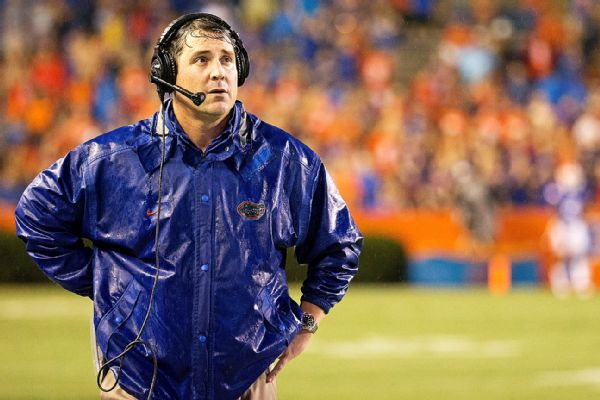
Rob Foldy/Getty ImagesWill Muschamp acknowledged that his Gators have plenty to work on following a triple overtime win over Kentucky.
GAINESVILLE, Fla. -- It was 2013 all over again for the Florida Gators, and then suddenly it wasn't.
Against an opponent Florida used to beat year after year, the miscues and maladies returned and a mighty streak in the Swamp was in doubt. Pass-protection gaffes, blown assignments on defense, bad penalties, key drops, and a missed field goal -- it was hard not to think about Florida's disastrous 4-8 season a year ago.
"We certainly made it interesting," said a visibly disappointed Florida coach Will Muschamp afterward.
His Gators squeaked past Kentucky, 36-30 in triple overtime Saturday night. They were down to their last breath on more than one occasion. Talk of Muschamp's future at UF swirled on social media.
When it was over, stunned fans walked out of the stadium with dazed looks in their eyes, not sure of what they had just seen.
But there was one overwhelming difference -- Florida won the game.
"Never a doubt," athletic director Jeremy Foley joked.
Foley and Muschamp exited the field arm in arm after the Gators dodged what would have been a crushing upset by Kentucky.
"I don't really feel relief after games," said Muschamp, who acknowledged his team has a lot to work on. "I look at it from a technical standpoint of we've got to clean some things up in the back end.
"Our guys fought. It wasn't always pretty at times."
This time the Gators didn't give in when an inspired opponent wrestled away momentum in the third quarter. The "woe is me" mentality that Muschamp said infected his team in 2013 was not on display.
These 2014 Gators stayed together.
"It's so different," sophomore safety Keanu Neal said. "I think it's because we're more of a unit this year. Offensively you can tell that we're together. Defensively you can tell we're together. And as a team we're just all here for one purpose. You can see that this year versus last year."
Fortified by a much stronger belief in their offensive system, the Gators say there was no panic.
"Not at all, and that's what I think was so great about the victory," said senior left tackle Chaz Green. "It's good that we faced a game like this early in the season. It's good for our team, and I think it shows we're willing and ready to respond to any situation. ...
"I would say that was a big step. You could say [last year's team would have lost], but that's behind us. We just want to focus on this year."
The biggest difference in Florida one year later, according to Muschamp, is an offense that can pull its weight and keep up in a shootout.
The Gators and Wildcats combined for nearly 1,000 total yards of offense on Saturday night. Last year, Florida and its opponents combined to average just under 621 yards a game in 12 contests.
"We're explosive enough offensively to get in a game like that and know we can make some plays," Muschamp said. "We gave up some things on the back end secondary-wise, but we didn't blink on the side. We knew no matter if we got down one score, two scores, we're explosive enough offensively to go make some plays.
"Quite frankly, as we moved forward in the season last year we weren't. As a competitor you don't ever want to admit something like that, but it's hard not to at times when you struggle to score 10 points."
Nine months later it's easy for Muschamp to admit how badly his team struggled in 2013. It's even easier to highlight the positives on display in this new season when your team is still undefeated.
Winning has a way of brightening every mood, and the beleaguered coach was no different late Saturday night. While some folks walked away with frazzled nerves, Muschamp found humor in providing Gator fans with bonus football.
"More than anything we missed us some football in the [cancelled] Idaho game," he said. "We figured we'd give you all a little extra shot of some ball. It's paying the fans back."
SEC helmet stickers: Week 3
Demarcus Robinson, Florida: The Gators fought tooth-and-nail for their 36-30 triple-overtime win over Kentucky and Robinson came up huge. The sophomore receiver hauled in 15 passes for 216 yards and two touchdowns and the Gators needed every bit of the performance in the victory.
Patrick Towles, Kentucky: The Wildcats weren't able to pull out the win, but Towles, who is in his first season as Kentucky's full-time starting quarterback, played a heck of a game. He was 24-of-45 passing for 369 yards and three touchdowns. He did have three interceptions, but one of those was not his fault and his performance was gritty in a tough environment (The Swamp). Also, honorable mention to true freshman receiver Garrett Johnson, who hauled in six of Towles' passes for 154 yards and two touchdowns, including this great catch.
--
--
GATORS: ONE VOICE ON SATURDAY - NO VOICE ON SUNDAY!
1996 National Football Champions | 2006 National Basketball Champions
2006 National Football Champions | 2007 National Basketball Champions
2008 National Football Champions |
Three Heisman Trophy winners: Steve Spurrier (1966), Danny Wuerffel (1996),
Tim Tebow (2007) - Visit our website at www.gatornet.us
---
You received this message because you are subscribed to the Google Groups "GatorNews" group.
To unsubscribe from this group and stop receiving emails from it, send an email to gatornews+unsubscribe@googlegroups.com.
For more options, visit https://groups.google.com/d/optout.

No comments:
Post a Comment